
There's an old rule in Sydney property: as a buyer, avoid auction at all costs. But right now, with clearance rates hovering around 50%, I'm being asked if that golden rule has finally changed. My answer might surprise you.
For years, the numbers told a clear story. In a vendor's market, auctions work for sellers. In a buyer's market, they work even more in favour of buyers who know how to use the dynamics. But what happens when the market sits right in the middle? That's where we are now, and it's worth unpacking.
Understanding what the clearance rate really tells us
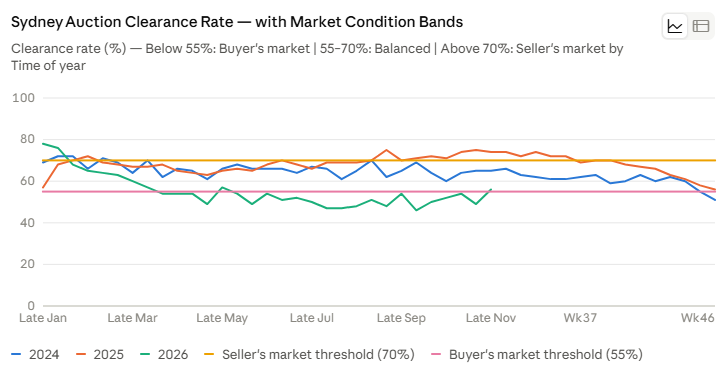
Let me start with the data that's driving this conversation. In Sydney, we use auction clearance rates as a market health indicator, and the thresholds are pretty consistent. A clearance rate consistently above 70% suggests the market favours vendors. Between 55% and 70%, you're looking at a balanced market. Below 55%, buyers have more choice and less pressure to overpay.
This year, we've been tracking around 50% consistently. That's a significant shift. For context, that number reflects a genuine softening compared to the last couple of years. Even more telling, we saw further decline after the May federal budget announcements came through. On the surface, that looks like good news for buyers. Lower clearance rates mean more properties aren't selling on the day, which creates flexibility and negotiating power.
But here's the thing about noise in the data: when stock levels drop, the clearance rate can bounce around. Easter weekends always show lower clearance rates because there are fewer auctions. Spring typically lifts them. This year especially, we're working off a much lower base of total properties going to auction, which means individual results carry more weight. The headline number of 50% is real, but it's worth thinking about what's actually driving it.
Why are properties going to auction right now?
If the market is softer, you'd expect more vendors to accept pre-auction offers. Yet auctions still happen. I've been to two in recent weeks, and they tell two very different stories about why agents choose the auction platform.
The first reason is the unrealistic vendor. These are owners whose price expectations sit so far above where the market actually values the property that no buyer would pay it before auction. The agent knows this. The only way to get the vendor to accept reality is to put the property in front of bidders, let them see how many actually show up, watch where people stop bidding, and let the market speak for itself. It's uncomfortable for everyone, but it's sometimes necessary.
The second reason is completely different: the agent has a genuinely strong asset with multiple serious buyers lined up. In that scenario, the auction platform isn't about finding a buyer, it's about maximising the price for a vendor who already knows they'll sell. If an agent has three or four qualified buyers, running to auction beats negotiating one-on-one, because emotion and competition drive the price higher on the day.
When a vendor's expectations meet reality
I walked into one auction recently where the agent was expecting three registrations. We were the only ones to register. Before things got started, I asked the agent directly what the reserve was. They'd set it at 1,870,000 on a 1.7 million guide. Top of the range. The vendors had clearly held a different view of their property's value than what was actually available in the market.
We didn't see value anywhere near that price. We were significantly under it. Now, there's an argument that value isn't determined by who shows up on a Saturday at 2pm. Fair point. But this property had been on the market for four weeks. The agent had expected three bidders. Two didn't show. We did, and we saw value at the lower end of their guide. The vendors wouldn't move on price.
We walked away. And that's the critical point here: an owner's reserve price isn't the market value. It's just their asking price, delivered with more finality. They might sell next week or next month at that number, or they might drop it eventually. But standing in an auction room with no competition doesn't suddenly make their reserve the right price. It just means no one's willing to pay it.
When a strong asset meets multiple buyers
The second auction I attended was a small terrace in Surrey Hills on just 38 square metres of land. The building and pest was average. The property was hard to add genuine value to. And the owners were motivated, though motivated at a premium price.
My client and I would have made a strong pre-auction offer. It would have been close enough to get the vendor seriously thinking. But the agent's position was absolute: the owners wanted to go to auction to test the market at their preferred price point. So we did.
We set our maximum based on realistic value for 38 square metres. We bid hard but stayed disciplined. The property sold for 10,000 above our final bid. Strong price for what it is, all things considered, in these market conditions.
So are buyers actually better off at auction now?
The short answer is no. And let me be clear about why, because it cuts through the noise of the clearance rate conversation.
First, the goal isn't to go to an auction. The goal is to buy a property at a price where you see value. If the vendor isn't willing to sell at that price, the auction is just a waste of your time and energy. You'll be standing there, emotionally invested, watching other people bid, and the dynamics of that room will push you higher than you'd ever agree to over the phone.
Second, and more broadly: in the Sydney market, most bidders at auctions are willing to pay an emotional price. Higher than they'd ever agree to in a private negotiation. I've seen enough of both to know this with certainty. You're genuinely better off not being in that room, bidding against emotion and ego.
The reality is, as a Sydney buyer, you often don't have the luxury of avoiding auctions entirely. Many properties do go this way. But if you can avoid them, you should. And if you're in one, the best outcome is the one where you walk away knowing you're not overpaying, even if it means losing the property.
Ready to make a move?
The current market is actually quite favourable for smart buyers who understand the landscape. If you're looking to purchase and want to navigate auctions, clearance rates, and realistic pricing, let's talk. Book a call with me and we can map out a strategy that works for your situation: https://buyr.at/b/penny-vandenhurk-15-min
