
The Pricing Mistake that Costs Buyers Thousands
Every comparable sale you look at happened in the past. That sounds obvious, but it's the first thing buyers forget. The market moves, sometimes quickly, so the age of a sale matters as much as the sale itself. I like to work with sales from the last three months. If I can't get enough genuine comparable in that window, I'll stretch to six months, but I'm always mentally adjusting for how the market has shifted since that sale settled.
BRACKETING THE VALUE, NOT GUESSING A NUMBER
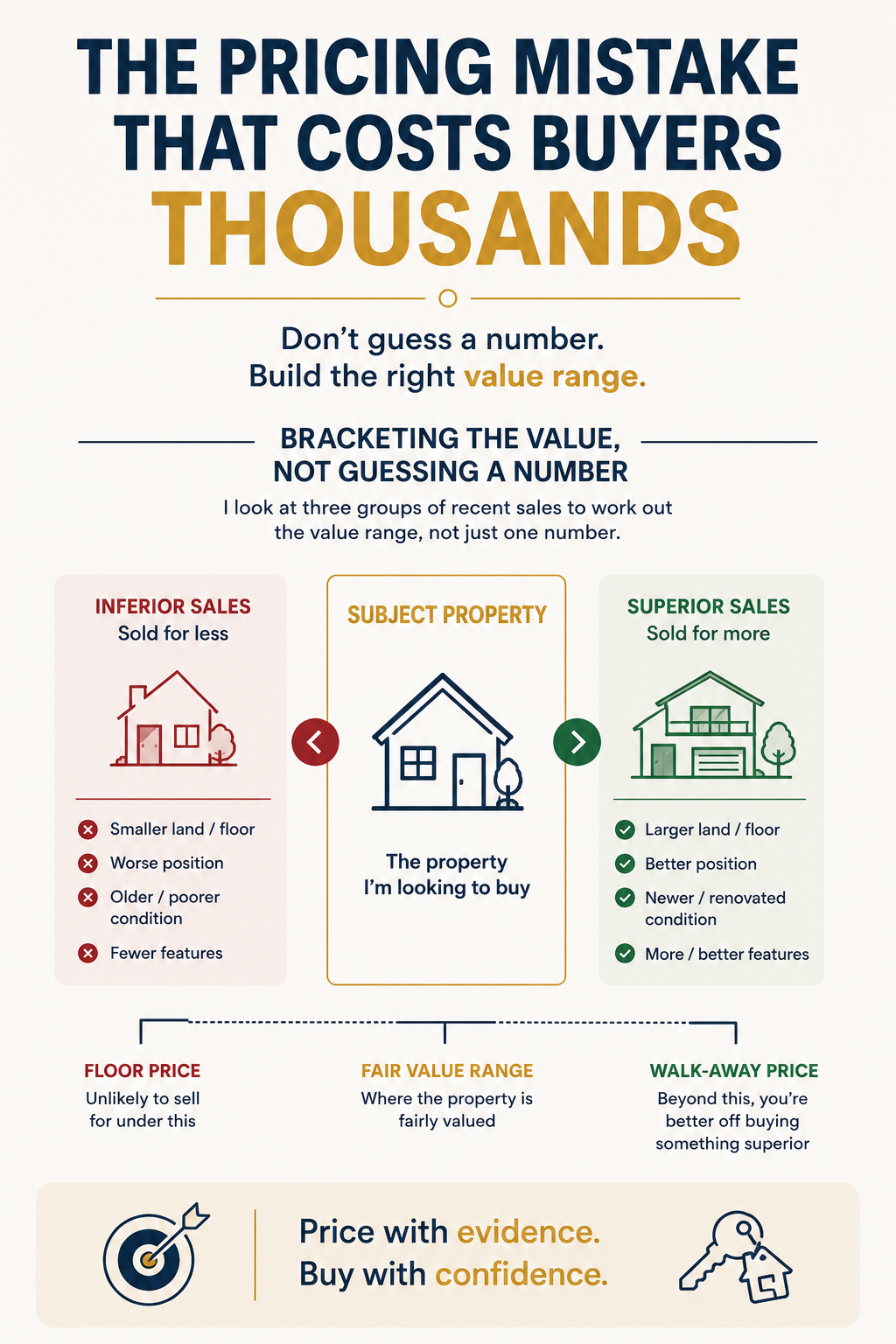
I don't go looking for properties that match my gut feel. I deliberately look at three groups: properties that sold for less and are genuinely inferior, properties that sold for more and are genuinely superior, and everything sitting in between. That range is what tells me the story. If I only looked at the sales that supported a number I already had in mind, I'd be fooling myself and my client.
MATCHING CHARACTERISTICS, NOT JUST SUBURB AND BEDROOM COUNT
Location and bedroom count are the starting filters, not the finish line. Same suburb ideally, and if it's a large or varied suburb, I narrow it down to the pocket that's genuinely comparable to the subject property. Bedrooms, bathrooms, and car spaces matter, but not always in the way people assume. On a house, a four-bedroom and a five-bedroom often sell within a similar range. On an apartment, I sometimes need to widen my net to include one and two-bathroom two-bedders just to get a decent sample size.
Land size, or floor size for apartments, comes next. Then the details that genuinely move the number: single or double level, pool or no pool, whether parking is a car space or a lock-up garage with storage, rear lane access, and condition. Is it liveable but scoped for renovation? Renovated in the last ten years, or the last twelve months? Every one of these shifts value, and no two properties, not even side-by-side duplexes, are ever truly identical. Aspect and what's next door both play a part. A property beside a house will usually outsell an identical one beside a block of apartments.
WORKING OUT WHAT YOU CAN AND CAN'T CHANGE
Once I've got the comparables in a table, sorted from highest sale price to lowest, I start separating the fixed features from the fixable ones. A main road position is permanent. It will always weigh on value and there's nothing an owner can do about it. A dated kitchen is temporary. It affects value less, because it's something a buyer can change. This distinction is what separates a rough guess from a considered valuation.
LANDING ON A RANGE, NOT A NUMBER
Pricing a property was never going to be exact to the dollar, and it shouldn't be treated that way. What I'm really solving for is a range: a floor it's unlikely to sell under, and a ceiling where paying more stops making sense, because at that point you'd be better off buying something genuinely superior instead. That range becomes your starting position and your walk-away point.
From there, strategy takes over. What I know about the agent, how they run a campaign, and the vendor's circumstances all shape how I use that range to actually get an offer accepted.
READY TO MAKE A MOVE?
If you're finding it hard to pin down a property's value in this market, or you've got the number right but can't get an offer over the line, that's exactly what my Acquisition Strategy service is for. You find the property, I help you buy it well. Book a call if you'd like a hand: https://buyr.at/b/penny-vandenhurk-15-min
