
The headlines about cracking towers, flammable cladding, and defect-ridden new builds have done a number on buyer confidence. The assumption has become: old building equals safe, new building equals risky. I understand the instinct. On face value, I agree with it. But the reality is more nuanced, and a blanket rule in either direction can cost you significantly.
The Question You Actually Need to Ask
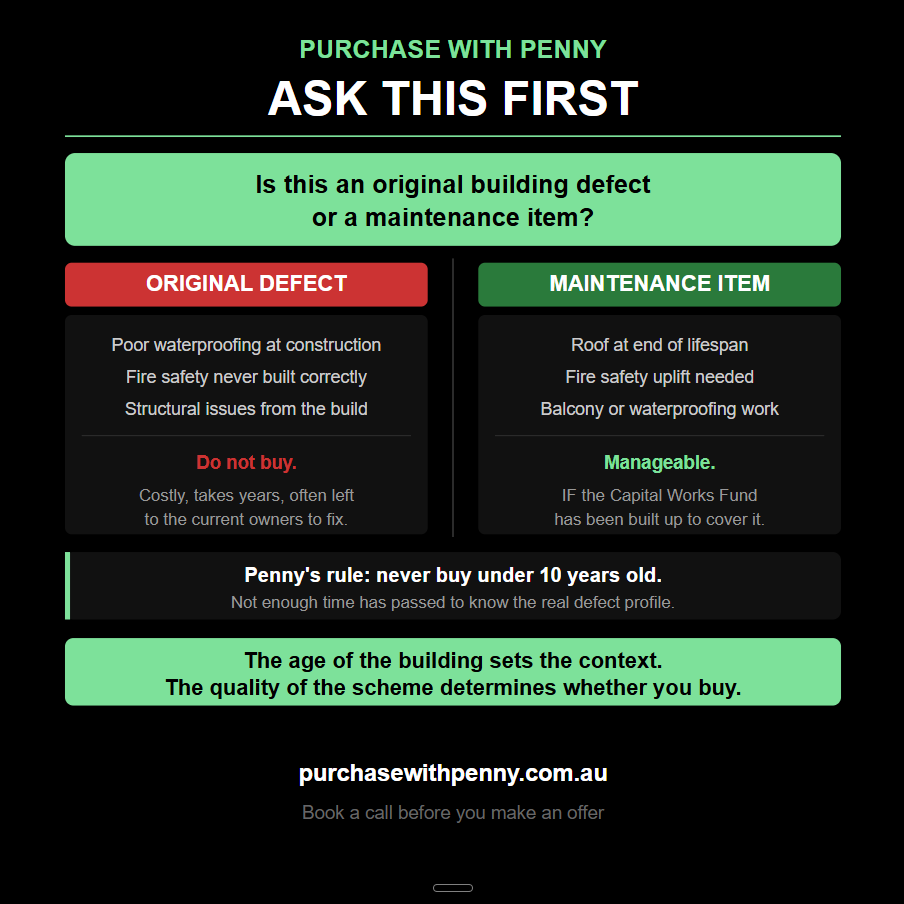
Before anything else, the most useful way to think about any apartment building is this: are the issues present a building defect from origination, or are they a maintenance item?
An original building defect is a reason not to buy. Full stop. Poor waterproofing baked into the structure, defects in fire safety systems that were never built correctly, structural issues from construction. These are expensive to rectify once a building is up and occupied, and they can take years to resolve, often at the cost of the current owners, not the developer.
A maintenance item is different. It's something that has run its course and needs replacing, and the question becomes whether the strata has been financially preparing for it.
This distinction is the lens through which you should read every strata report.
Why I Tell My Clients Not to Buy Under 10 Years Old
There is a six-year builder's warranty period in New South Wales. Sounds reassuring. In practice, it offers far less protection than buyers assume.
Just this week I had to advise a client against purchasing an apartment in Waterloo. The original builder had agreed to rectify all defects at their own cost. Sounds fine, except the builder is now in voluntary administration. At some point, that money runs out. The defects that remain will be left for whoever owns those apartments at the time, and they will spend years navigating special levies, strata loans, and enormous disruption trying to fix work that was never done properly.
A builder's warranty is only as good as the builder still being in business. Many aren't.
This is why my advice is straightforward: do not buy an apartment in a building that is less than 10 years old. You simply have not had enough time pass to understand the true defect and risk profile of the building. The warranty period is not a safety net you can rely on.
Older Buildings Are Not Exempt
That said, I want to be direct: older does not mean problem-free. Older buildings have maintenance needs, and some of them are significant.
Last year I reviewed an apartment on Fort Street in Petersham for a client. It was a block of four, so small and simple as schemes go. But the entire roof needed to be replaced and re-waterproofed. The cost worked out to approximately $100,000 per one-bedroom unit in a special levy. For a one-bedroom apartment, that is a number that changes the financial case for the purchase entirely.
There are a handful of specific things I look for in older buildings beyond the obvious:
Waterproofing in bathrooms. There is an important legal nuance here. If an owner has never renovated their bathroom and the original waterproofing fails over time, that is the strata's responsibility to rectify. If an owner has updated their bathroom, the waterproofing becomes their responsibility. In an older block with a mix of renovated and original bathrooms, you can end up with differing obligations and ongoing disputes about who pays for what.
Fire safety. Older buildings may not currently be required to comply with today's annual fire safety statement requirements. But council can issue a fire order at any point, requiring the building to uplift to modern standards. The law can also change. Replacing each unit's front door with a compliant fire door costs approximately $3,000 to $4,000 per apartment. Fire safety is not a defect, but it is a real cost that many buyers simply do not have on their radar when assessing an older building.
Balcony balustrades. Many older balustrades do not meet current code height requirements. This does not trigger an immediate obligation, but if the balconies require any repair or re-waterproofing work, the balustrades must be brought up to current standards at the same time. What looks like a straightforward balcony repair can quickly become a much larger cost.
Concrete cancer and spalling. Common in older concrete structures, particularly in coastal areas or buildings exposed to moisture. The extent matters, and it needs to be factored into the financial picture.
Roof replacement. Not always a defect, sometimes just the end of a lifespan. A roof that has reached 40 or 50 years and is no longer keeping water out of the top floor apartments needs replacing regardless of whether anyone did anything wrong.
What You're Actually Buying Into
Buying an apartment in Sydney is genuinely harder than buying a house, because you are buying into a collective. The strata scheme, the owners corporation, the committee, the financials: these are not footnotes. They are the product.
What I want to see in any building I'm considering for a client is a strata that has been doing its job. A Capital Works Fund that reflects the real likely costs of the building's future maintenance. A 10-year Capital Works Plan that broadly tracks to those projected needs. A scheme that is building reserves so that when the roof does need replacing, or the fire safety uplift comes through, the money is largely there, and owners are not suddenly hit with a special levy or, worse, required to take out a strata loan.
Special levies and strata loans are not the end of the world, but they are a sign that the scheme has been underprepared and underfunded. They can also affect your ability to sell, because any incoming buyer's solicitor will spot them immediately.
The Framework I Use
For buildings under 10 years old: I do not recommend them. The risk is too high and the track record too short.
For buildings 10 years and older: the assessment shifts to these questions. Are any issues present original building defects that still haven't been resolved, and if so, why not? Or are they maintenance items, and has the scheme been financially preparing for them? Is there a funded 10-year Capital Works Plan? What do the meeting minutes actually say? Have there been special levies, and what were they for?
The age of the building sets the context. The quality of the scheme determines whether you buy.
Ready to Buy an Apartment in Sydney?
This is exactly the kind of analysis I work through for every client before an offer is made. If you would like expert guidance on the strata, the building, and whether the numbers stack up before you commit, I would love to talk.
Book a call here: https://buyr.at/b/penny-vandenhurk-15-min
