
Who actually decides if a property sells?
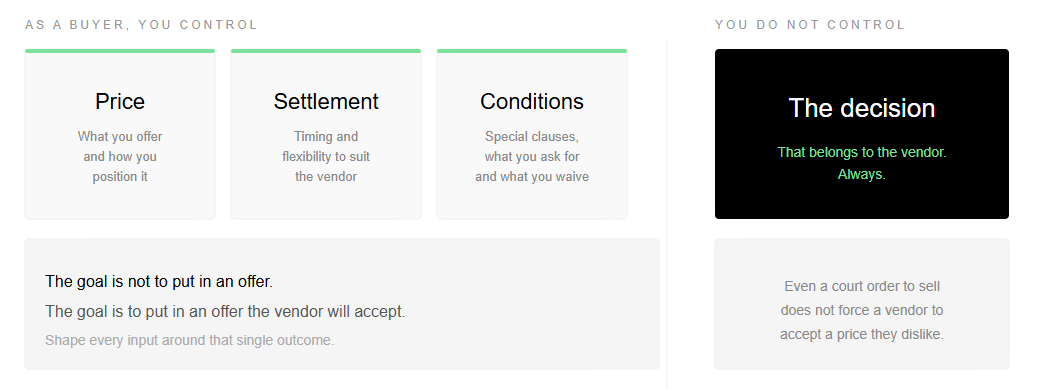
Most buyers think the goal is to put in an offer. It isn't. The goal is to put in an offer that gets accepted. That one shift in thinking changes everything about how you approach buying property.
I asked this question on social media this week after a conversation with a prospective client, and the answers were split. Some said the buyer. Some said the agent. A few said the solicitor. Very few landed on the right answer straightaway: the vendor.
The vendor is the only person in the entire transaction who can decide whether a property sells. Full stop. Anyone else in the deal can get in the way. The buyer can walk. The agent can mishandle the negotiation. The buyer's solicitor can raise an objection. The vendor's solicitor can create friction. Any one of those parties can break a deal. But only one party can say yes, and that is the person who owns the property.
Why this matters more than most buyers realise
In the current market, I keep seeing the same pattern. Buyers treat the offer as the goal. Get an offer in, tick the box, wait and see. The problem with that approach is that it treats the negotiation as something that happens to you rather than something you shape.
The vendor is not waiting for just any offer. They are waiting for the right offer, and what makes an offer right is different for every vendor. For some it's price. For some it's settlement timing. For others it's certainty, minimal conditions, a quick exchange. If you don't know what matters to the vendor, your offer is a guess.
You have more control than you think, just not over the outcome
Here's where buyers tend to lose the thread. Because the vendor is the decision maker, buyers feel like they have no control. That isn't true. You have considerable control over the inputs. Price, settlement period, special conditions, what you leave on the table, what you push for. All of those levers are yours to pull.
What you don't control is the decision. No offer is so good that a vendor is legally or practically obligated to accept it. Even in circumstances where a sale feels like a certainty, the vendor retains the power to say no.
I want to be clear: I'm not saying you never put in a lower first offer as part of a strategy. There are absolutely situations where your first offer is a positioning move, where you want to show room to move and get to a second or third offer at a number you're genuinely happy with. That's different from throwing an offer out there with no strategy and hoping for the best.
Even a court order doesn't guarantee a sale
I've been working with a client on a property where the vendor was under a family court order to sell. The clause was triggered when the youngest child left home, and the property was listed. Buyers looking at this situation might assume the vendor has no choice.
They do have a choice.
Even with a court order in place, the vendor is not required to accept a price they are unhappy with. Court orders can be amended. Timeframes can be extended. If the vendor decides the offers on the table are not acceptable, they can go back to the court, negotiate with the other party, and buy themselves more time. No buyer can force a sale at a price the vendor doesn't want.
This comes up more often than people realise. A vendor in financial difficulty, a deceased estate, a divorce settlement, a forced sale scenario: buyers often assume these circumstances guarantee a favourable price or a more urgent vendor. Sometimes they do. Sometimes they don't. The vendor's motivation is real information you need to gather carefully, not an assumption you can safely make.
What to do with this as a buyer
Reframe your objective. Your goal is not to put in an offer. Your goal is to put in an offer that gets a yes. That means understanding what the vendor actually needs from this sale, presenting your offer in a way that speaks to those needs, and working with an agent and your own representative to position yourself as the most attractive buyer, not just the one who got there first.
Know what you can control and focus your energy there. Price matters, but it isn't always the only thing. Settlement flexibility, unconditional offers, speed of exchange, all of these have real value to certain vendors. Learn what matters in each individual situation.
And accept that the final decision is not yours. That's not a powerless position. It's just an honest one. When you understand where the power actually sits in a transaction, you can work with it rather than against it.
Ready to make a move?
If you're in the market and want to understand how to position yourself as the buyer that vendors want to say yes to, I'd love to help. Book a call at https://buyr.at/b/penny-vandenhurk-15-min and we'll work through your strategy together.
